


Let's talk about Hinges.
- info079834
- Jun 10, 2025
- 5 min read
A guide to hinges – their design, style and purpose.
It is not just the style of door that you must consider when selecting your doors, you also have options for your door hardware and more specifically for your door hinges. There are distinct types of hinges for diverse types of doors, although they are not just functional, but can also be added for aesthetics. Although hinges might not be the most exciting or interesting part of a door, they are the most integral to its function. Here is what you need to know about interior and exterior door hinges and what can influence your decision. Below, we talk about what you need to know about the types of hinges, materials, and sizes and how that pertains to door construction as well as finish.
Parts of a Hinge
There are 4 essential parts of a common hinge. These components are as follows:
Hinge leaf: Hinge leaves are the parts of the hinge that you screw into the door frame and the edge of the door—one hinge leaf per hinge for each surface. These leaves can have 3 to four screw holes each and the patterns of the screws is either an S pattern or a D pattern, so called because of their pattern matching the shape of the letters.
Knuckle: The knuckle is the cylindrical part of the hinge that is attached to the leaf through which the pin passes.
Barrel: Once the two leaves are aligned, the barrel is the stacked number of knuckles.
Pin: The pin is the long, thin, pencil-like piece that slides through the barrel to keep the hinge leaves together.
Types of Hinges
Let us talk about types of hinges interior and exterior doors for your home: butt hinges, ball-bearing hinges, Non-Removable Pin (NRP) hinges, residential vs commercial hinges, Spring aka self-closing hinges, and concealed hinges. There are many more types of hinges and all for different applications, but for now, we will focus on these common door swing hinges.

Butt hinges are the most common hinges that you will find on home interior and exterior doors. As far as structural capability, they are medium duty to heavy-duty, which is determined by their size and the material from which they are made. They can range from 3.5” high which is common for a 1-3/8” thick interior doors, 4” which is common for 1-3/4” thick doors, and up to 5” for doors thicker than 1 ¾". Basic hinges are usually made of steel and come in a variety of finishes.
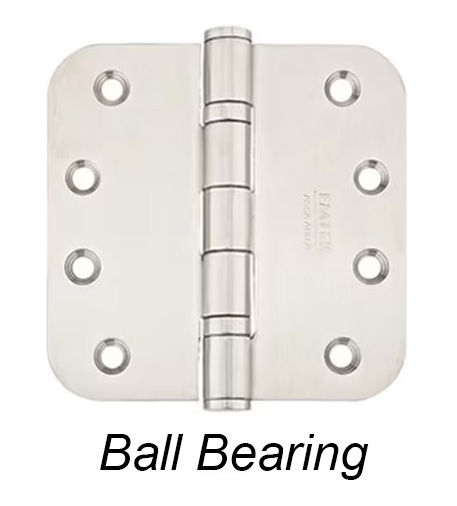
Where the common residential hinge is great for most common swing door applications, if you are dealing with an unusually wide, thick, or particularly heavy door, that is where the ball bearing hinges come into play. Ball bearing hinges are used for doors that are heavier, over 2” thick, or doors that are over 40” wide; these are not attributes of your basic interior door, but you will need to call on these hinges in extended circumstances.
The same is true for the Non-Removable Pin Hinge (NRP Hinge), which is used only for exterior doors that swing outward that cause the hinge to be on the outside. The fixed pin in the hinge allows for security as they have a set screw inside the barrel of the hinge that is only accessible when the door is open. NRP Hinges do not have immediate recognizable differences from its colleague, the butt hinge. However, the ball bearing does as it exhibits two ball bearings that rest in between the knuckles in the barrel of the hinge.

Spring Hinges are the beast of the door hinge family. These hinges are meant for self-closing and are not meant for a regular interior door. Called “spring” because they have an automatic closing device inside, they are widely used in real-life applications for lots of large and small items such as cabinet doors, eyeglasses, box lids, handheld tools, and more. In the case of doors, they are used in commercial applications, but more importantly they are required for all fire-rated doors. These large hinges are meant to close your fire- rated door, required for all garages, automatically so that your home is better protected from a fire that may occur in your garage.
For butt, ball bearing, NRP, and spring hinges, we offer several options from our vendors. For basic hinge profiles, we recommend the stainless- steel hinges from K&M Wholesale and SGS Hardware. For more custom solutions with more decorative options and stainless steel and brass hinges, we recommend Emtek and Baldwin Hardware. For other custom solutions, feel free to ask us about other vendors.
Concealed hinges are a category all to themselves. Also known as European hinges or invisible hinges, the concealed hinge is designed to be out of sight when the door is closed. They are mounted on the inside of the door and frame for a clean look, and flush with the door to conceal themselves. These hinges are sleek and difficult. They do cause more labor to install than regular hinges as they require adjustment and precision. Not found in most hinge vendor catalogues, our two sources for concealed hinges are SOSS Door Hardware and Tectus, and these hinges come in a variety of leaf designs, pin sizes, lengths and colors.
Materials and Durability
Residential Hinges vs Commercial Hinges: The primary difference between residential and commercial hinges is the thickness of the metal and its durability. Commercial hinges have thicker leaves and a larger knuckle diameter. Their durability allows them to deal with heavy duty applications in commercial and industrial locations, while residential hinges are typically used for lighter doors and lighter use. In the everyday home atmosphere, the heavy-duty structure, increased durability, and cost of commercial hinges are unnecessary.
Stainless Steel Hinges vs Brass Hinges: Although stainless steel is common, brass hinges are also available for a premium. Brass hinges are much more expensive. However, as in cases when it comes to building materials, with a higher premium comes a superior quality. Due to the combination of copper and zinc, brass has exceptional durability and strength and lasts longer and is lower maintenance than stainless steel hinges.
Finish
Unlike commercial hinges, you can customize residential hinges with accents, hinge corner options, and styling that is not available with commercial hinges. Commercial hinges have limited options in style, other than different colors, whereas residential butt hinges can have 5/8” radius, ¼” radius and square corners of their leaves as well as changing out the tip design from flat to ball, steeple and much more.


From square and round barrels, colors and finishes, even custom designs like hammered metal and vine door designs, you can find many more options of door hinges than you ever imagined... and we haven’t even discussed mortise hinges, butterfly hinges, pivot or knife hinges and so many more. Let us know how we can help you choose the optimal hinge for your door project today!
If you are in the Greater Seattle area, we want to know how we can help you make the right decision when it comes to replacing your interior or exterior doors. We have been providing quality doors and millwork to the Greater Seattle area since 1990 and are ready to help you start your next project. Give us a call at Interbay Door today!
425-485-6404
References:
MasterClass, Article, “Guide to Hinges: 13 types of Hinges,” Home and Lifestyle, July 16, 2021, Guide to Hinges: 13 Types of Hinges - 2025 - MasterClass
Robinson, Jaime, Article: “What are the different types of door hinges.” Value Doors and Windows, March 5, 2025, What Are The Different Types Of Door Hinges - Types & Best Hinge
Anonymous, Blog: “Difference between residential and commercial hinges.” Direct Door Hardware, December, 12, 2020, Difference Between Residential and Commerical Hinges


Comments